August 11, 2026
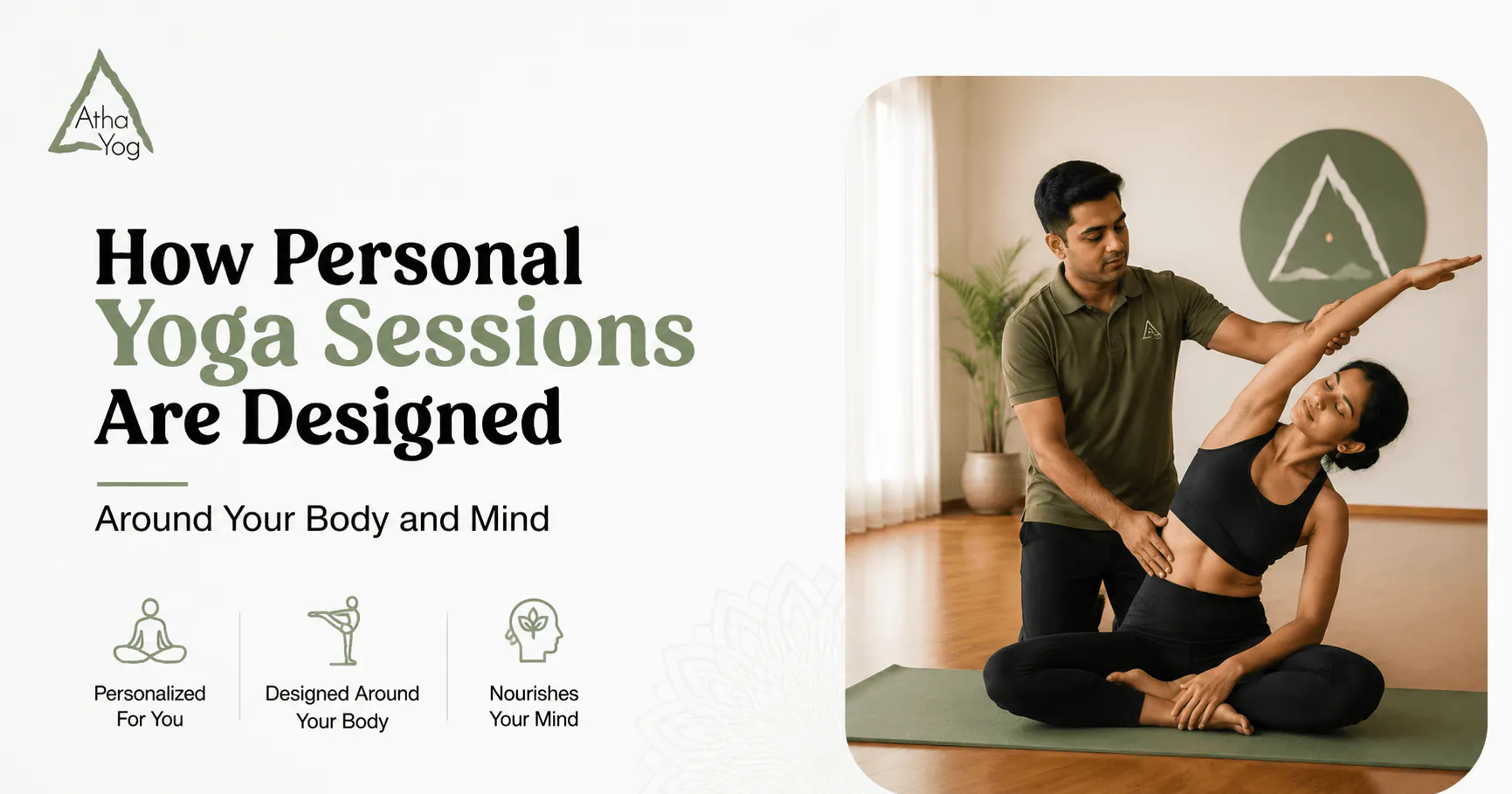
In a world of group schedules and fixed routines, personal attention has become rare. Especially in wellness.
Many people begin yoga in group classes. They follow cues, move with the flow, and try to keep up. For some, this works beautifully. For others, something feels slightly misaligned. The pace may feel too fast. A posture may trigger discomfort. Breath awareness may be used. Questions may remain unasked.
This is where personal yoga sessions begin to make sense.
If you are in Bengaluru, particularly around Indiranagar, and wondering whether one-on-one yoga could support you better, this guide explains how personal sessions are intentionally designed around your body, your lifestyle, and your mental state.
Personal yoga is not a luxury add-on. According to the Global Wellness Institute, yoga therapy combines a clinically oriented, assessment-based, and personalised approach tailored around an individual's goals and health conditions, making it a precision approach to wellness rather than a general one.
What Makes Personal Yoga Different from Group Classes
In group classes, instruction is general. Even with experienced teachers, guidance must seethe majority. This means sequencing, pace, and intensity are structured for collective benefit.
In personal yoga sessions, everything shifts.
The session is designed around:
The teacher observes how you move, where you compensate, how you breathe, and how you respond to effort. From there, practice is adapted in real time.
The difference is not only physical. It is psychological.
When attention is undivided, the nervous system relaxes more quickly. You are not comparing yourself. You are not keeping up. You are simply learning.
This shift in dynamic also changes the relationship with practice itself. In group settings, yoga can quietly become performance. In personal sessions, it becomes an inquiry. The instructor is not evaluating you. They are observing with you. This distinction matters more than it sounds. When self-consciousness reduces, breath deepens, movement becomes more honest, and the body reveals patterns it ordinarily guards. That quality of honest movement is where real correction and real progress begin.
Personal Yoga vs Group Yoga: At a Glance
| Factor | Group Class | Personal Session |
|---|---|---|
| Instruction style | General, collective | Individual, adaptive |
| Pace | Fixed for the group | Adjusted to you |
| Alignment correction | Occasional | Consistent |
| Breath guidance | Encouraged | Actively refined |
| Mental state consideration | Minimal | Central to session design |
| Injury accommodation | Limited | Fully incorporated |
Step One: Assessment Before Asana
A well-structured personal session does not begin with random stretches. It begins with observation.
A qualified instructor typically assesses:
This initial assessment guides the structure of future sessions.
For example, a desk-based professional may need thoracic mobility and hip opening more than advanced backbends. Someone experiencing burnout may need restorative sequencing more than intensity.
Personal yoga removes guesswork.
| Assessment Area | What the Instructor Observes | Why It Matters |
|---|---|---|
| Standing posture | Spinal alignment, weight distribution | Identifies compensatory patterns |
| Shoulder and hip mobility | Range of motion, stiffness | Guides sequencing decisions |
| Breathing depth | Chest vs diaphragmatic breathing | Reveals nervous system state |
| Core stability | Engagement under load | Prevents injury during practice |
| Lifestyle patterns | Sitting hours, sleep, stress levels | Contextualises physical findings |
Step Two: Designing Practice Around Your Body
No two bodies are identical. Even if two people appear equally flexible, their joint mobility, muscular engagement, and compensation patterns differ.
In personal sessions, sequencing may include:
Progression is layered. Instead of chasing complex postures, the focus shifts to:
Over time, this approach often leads to deeper transformation than pushing beyond readiness.
Step Three: Designing Practice Around Your Mind
Physical movement is only half of yoga.
Personal sessions also account for:
On high-stress days, the session may include longer exhalation breathwork to activate the parasympathetic response.
On low-energy days, gentle activation sequences may be used to stimulate circulation. Meditation components can be introduced gradually based on receptivity. Personal yoga adapts not only to how you look but also to how you feel.
This adaptability is particularly significant for individuals who carry stress in ways that are not immediately visible. Jaw tension, shallow breathing, and a slightly elevated resting heart rate are common indicators of a nervous system that has been in mild overdrive for a long time. A skilled personal yoga instructor learns to read these signals over time.
Sessions then become less about what postures are achieved and more about what the body is ready to release. That is a fundamentally different and more effective relationship with yoga.
Step Four: Integrating Breath and Nervous System Regulation
In many group classes, breath awareness is encouraged but not deeply corrected. In one-on-one sessions, breath becomes central.
The instructor may guide:
Because breath directly influences heart rate variability and stress response, refining breathing patterns can dramatically shift mental clarity.
Many clients report that breathwork alone transforms their daily stress tolerance.
Step Five: Correcting Imbalances and Preventing Injury
Personal yoga is particularly valuable for individuals managing:
Rather than avoiding movement, sessions are designed to build stability around sensitive areas.
The aim is not temporary relief. It is a structural correction and long-term resilience. This level of detail is difficult to achieve in large group formats.
It is worth noting that personal yoga in this context is not physiotherapy. It does not diagnose or treat medical conditions. What it does is build body awareness, strengthen the stabilising muscles around vulnerable joints, and correct the movement patterns that often contribute to recurring discomfort in the first place.
For individuals who have been told to rest indefinitely, or who have avoided movement out of fear of aggravating an injury, a well-guided personal session often becomes the first safe step back into the body.
Step Six: Integrating Practice into Daily Life
One overlooked benefit of personal yoga is accountability.
When sessions are scheduled regularly, practice becomes integrated into lifestyle rather than optional.
Instructors often provide:
Over time, clients begin making subtle but meaningful shifts:
Transformation becomes cumulative.
This cumulative quality is what separates a personal yoga practice from an occasional wellness activity. The body begins to associate scheduled sessions with safety and recovery. The nervous system learns predictability.
Over weeks, the effort required to show up and practise reduces, not because the practice becomes easier, but because it becomes familiar. Familiarity builds trust. Trust builds depth. And depth, in yoga, is where the most meaningful shifts quietly happen, often long before the practitioner consciously notices them.
Who Benefits Most From Personal Yoga
Personal sessions are especially beneficial for:
| Who Benefits | Why Personal Yoga Helps |
|---|---|
| Beginners | Learn alignment correctly from the start |
| Post-injury individuals | Safe, modified movement around sensitive areas |
| Professionals with burnout | Sessions adapt to the nervous system state |
| Long-term practitioners | Refine technique and deepen practice |
| Those with chronic discomfort | Targeted stability and postural correction |
| People returning after a break | Gradual, confidence-building reintroduction |
It is not about ability level. It is about intentionality.
Online and Offline Personal Yoga in Indiranagar
For those in Indiranagar, in-person yoga sessions offer direct correction and hands-on alignment guidance.
However, structured online personal sessions are also effective when guided carefully. With proper camera placement and attentive instruction, online sessions can deliver personalised attention for those balancing travel or demanding schedules.
The key is continuity.
Whether online or offline, what matters most is consistent observation and adaptive sequencing.
The Psychological Safety of One-on-One Practice
There is something deeply reassuring about being seen without judgment. In personal sessions:
This psychological safety often allows individuals to explore breath and stillness more comfortably than in group settings.
For many urban professionals, this consistency is the missing piece. They have knowledge, motivation, and access. What they lack is a structured, judgement-free environment where practice can be genuinely personal. The irony is that group classes, despite their energy and community, can sometimes make individuals feel more disconnected from their own practice.
One-on-one sessions remove the external reference points entirely. What remains is just you, your breath, your body, and a teacher whose only focus is your progress.
A Structured Approach in Indiranagar
AthaYog Living Yoga Academy, located in HAL 2nd Stage, Indiranagar, offers both in-studio and online personal yoga sessions designed for individual needs.
Their approach emphasises alignment, breath awareness, and steady progression rather than rapid advancement. Sessions are structured to integrate classical yogic principles with modern lifestyle demands.
For professionals navigating busy urban routines, having access to both offline and online personal guidance ensures that practice remains consistent even when schedules fluctuate.
Final Reflection
Personal yoga is not about exclusivity. It is about specificity.
When practice is shaped around your structure, your breath, and your mental rhythm, results become steadier and more sustainable.
In neighbourhoods like Indiranagar, where life rarely slows down, having a practice that adjusts to you rather than demanding that you adjust to it can quietly change how you live.
Sometimes, the most powerful shift happens not in a crowd, but in focused stillness.
+ 91 8690333111
info@athayogliving
Indiranagar
No.3293, Ist floor, 12th main, HAL 2nd stage, Indiranagar, Bengaluru, Karnataka - 560038
UPI, Google Pay, PhonePe, Paytm and more.
Visa, Mastercard, RuPay and more.
HDFC EMI, ICICI EMI, Bank of Baroda EMI, Federal Bank EMI and more.
Net Banking, Amazon Pay, MobiKwik, Pay Later and more.
Paypal and more.



Athayog Living 2024 All rights reserved
A Sanctum For The Spirit


Athayog Living 2024 All rights reserved
A Sanctum For The Spirit